Laying bare eczema and psoriasis
Neil Trainis,
28 Sep 2026 4 Min
4 Min

Neil Trainis,
28 Sep 20264 Min
Neil Trainis,
28 Sep 20264 Min


Eczema and psoriasis are often managed in primary care. And so, community pharmacists, especially independent prescribers, must feel confident in recognising these conditions and managing them effectively. Victoria Goldman reports…
Pharmacists and pharmacy teams are usually the first healthcare professionals to see anyone with a skin rash, whether this is caused by an acute complaint (such as an insect bite) or a long-term skin disease.
Mike Hewitson, an independent prescriber specialising in dermatology, says that most community pharmacists should be able to recognise eczema and psoriasis symptoms. However, he adds, it’s important that pharmacists don’t rely only on their eyes when making a diagnosis, as there are so many different skin conditions.
“Eczema is more likely to be diagnosed in childhood, but some specific types can occur later in life. For example, dyshidrotic (pompholyx) eczema can causes small, itchy blisters on the hands,” says Hewitson.
“So, a full history is important. Where is it? What are the symptoms? When did it start – suddenly or over a long period of time? What makes it better or worse? Ask about their family history and whether they have any other atopic conditions (asthma or hayfever). With psoriasis, it’s important to ask about any associated joint symptoms, which could indicate psoriatic arthritis.”
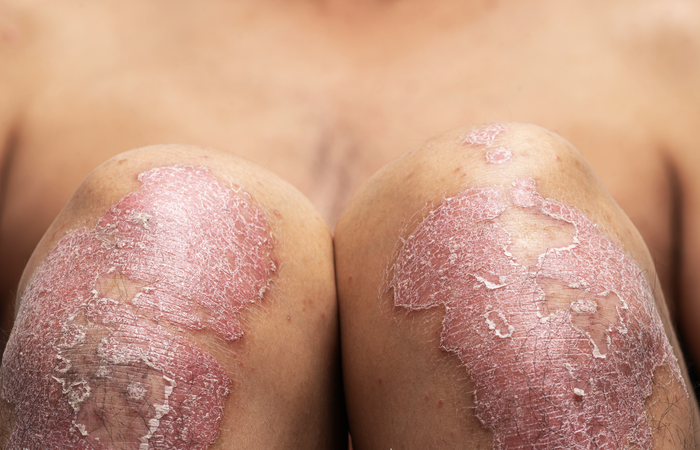
Skin rashes can look different on different skin tones. Atopic eczema usually causes severely dry, cracked skin, intense itching and inflamed rashes.
The rash may appear red on lighter skin, or dark brown, purple or ashen grey on darker skin tones. Eczema flare-ups can cause blistering, weeping fluid or thickened, leathery areas. Psoriasis can cause dry, itchy, sore and flaky patches of skin. The patches may be pink or red on paler skin (turning silvery white, waxy yellow or orange-brown), or grey on brown or black skin (turning darker).
Patients should be referred if pharmacists aren’t confident about the diagnosis or if the symptoms are severe or don’t respond to pharmacy management.
Skin conditions don’t only affect people’s physical health, so this should be taken into account when assessing the impact and severity. In July 2026, a new British Skin Foundation “Psychodermatology & Me” survey revealed that four in five people say their skin condition flare-ups leave them feeling anxious or depressed, with 64 per cent saying their skin condition affects their mental health every day.
Despite this, nearly three-quarters said a healthcare professional has never discussed the mental health impact of their symptoms.
Improving confidence
Tase Oputu, the president of the Royal College of Pharmacy, says that community pharmacists can build their confidence in assessing and advising on skin conditions through “continuing professional development, regular patient consultations, peer review discussions and keeping up to date with evidence-based clinical guidance”.
However, she adds, “as with any condition, pharmacist prescribers should only prescribe within their scope of competence, in line with the specifications of any commissioned service they are delivering, and where this forms part of their role.”
Professor Tess McPherson, a spokesperson for the British Association of Dermatologists (BAD), says the British College of Dermatology, the BAD’s educational arm (https://learning.bcd.org.uk/my/?categoryid=7), offers a dedicated pharmacy education series, including courses on eczema and psoriasis.
The Centre for Pharmacy Postgraduation Education (CPPE) also offers a range of resources for community pharmacists, including a dermatology e-learning programme.
“We are developing a new dermatology online workshop, which is due to launch in November 2026,” says Deborah Howard, regional manager North-West England and MBTI practitioner, who looks after CPPE’s dermatology resources.
“The workshop will introduce pharmacy professionals to effective clinical history-taking in relation to dermatology, identifying characteristics of skin rashes and lesions and recognising red flags to aid diagnosis and clinical decision-making.
“Participants in the workshop will have an opportunity to apply these skills to case studies, including one on psoriasis, and discuss how they would manage each case with their peers.”
Hewitson recommends that community pharmacists join the Primary Care Dermatological Society (www.pcds.org.uk), whose website includes clear diagnostic information.
“DermNet is another useful website (New Zealand based),” he says, “while Skin Deep (https://dftbskindeep.com) can help with diagnosing skin conditions in skin of colour. The University of Hertfordshire runs several courses on skin conditions, which can help to build pharmacists’ confidence.
“Community pharmacists could also build networks with more experienced colleagues so they can ask questions. However, if taking pictures for colleagues, it’s important to have patient consent before sharing these – and to have an appropriate app and storage device.”
Medicines management
During Medicines Safety Week in November 2025, Eczema UK reminded patients that understanding their treatments is key to managing eczema well: knowing the strength of their topical steroid, storing their emollients safely, and understanding when to use each product.
An Eczema UK survey of patients, dermatologists and other eczema healthcare professionals, earlier in 2026, found that almost one in five eczema patients said they don’t trust their eczema treatments.
Although three-quarters of patients said they use their eczema treatments as advised, healthcare professionals estimated that six in ten patients delay or avoid prescribed treatments.
Emollients are essential in eczema and psoriasis management but often underestimated.
“Patient education is very important to discuss expectations of emollients and how to use them properly,” says Mike Hewitson. “It’s also important to discuss the risks and benefits of each eczema treatment and to establish a management strategy – for example, discuss whether the patient should return to the pharmacy or go to their GP if their symptoms don’t get better in seven days.”
Using emollients regularly can help to prevent itching by keeping the skin well-moisturised. Scratching eczema creates a cycle of worsening itch that then leads to more scratching.
This can lead to long-term skin inflammation that is difficult to treat. The Scratch Less Study, led by the University of Nottingham and Nottingham University Hospitals NHS Trust, is examining how patients can break the eczema itch-scratch cycle with a short three-part programme called “Scratch Less”.
Almost 600 children and adults will take part, and the researchers are looking for volunteers aged eight years and older. Each volunteer will be asked to take part in the online programme for four months. They will continue with their eczema treatments as usual, while finding other ways to manage itching and scratching.
For more information, visit https://rapideczematrials.org/scratch-less-study/.