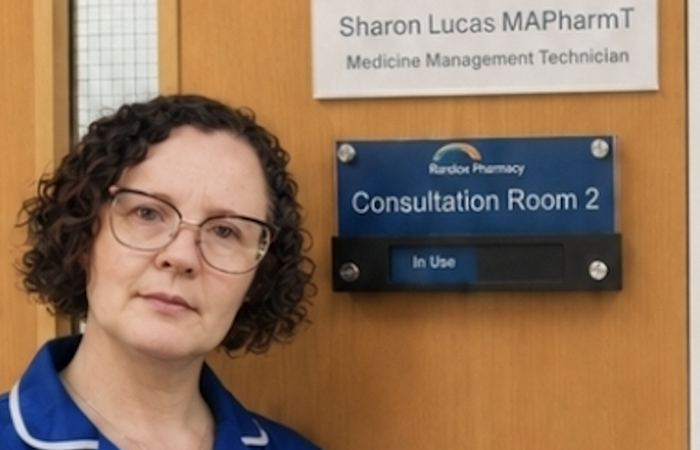
Talking technicians with Sharon Lucas
Neil Trainis,
18 Aug 2026 4 Min
4 Min

Neil Trainis,
18 Aug 20264 Min
Neil Trainis,
18 Aug 20264 Min


Pharmacy technician Sharon Lucas says legislation allowing her profession to supervise the preparation and supply of medicines is long overdue – but any expanded role should come with “an honest conversation” about salary, recognition and accountability. Saša Janković caught up with her…
As the sole pharmacy technician and an accuracy checking pharmacy technician at Rainbow Pharmacy in Ipswich, Sharon Lucas is an indispensable part of the team. She was also the winner of the Independent Pharmacy Awards Pharmacy Technician of the Year award last year.
Independent, family-run Rainbow Pharmacy offers a range of NHS and private services which Sharon helped roll out with superintendent pharmacist Ashwin Bhatt, including Pharmacy First, flu, Covid and RSV vaccinations, hypertension reviews and ABPM, contraception services and travel health and weight loss support.
Trained in hypertension monitoring, she diagnoses patients with high blood pressure and refers them to GPs for life-changing treatment, and her ear microsuction service has enabled numerous patients to regain their hearing and proceed with NHS hearing aid referrals.
Alongside this, Sharon mentors staff and writes SOPs, assists with MHRA alert management and supports the pharmacy quality scheme alongside Ashwin, sharing prescription checking and appointment scheduling responsibilities.
Expanded role
With a career spanning more than two decades across both community and primary care settings, and at Rainbow Pharmacy, Sharon says she “wholeheartedly supports” the forthcoming change in legislation which, from December, will allow pharmacy technicians to supervise the preparation and supply of medicines, giving them an even bigger role in the pharmacy.
“I have worked in pharmacy since 1999 so I have seen a huge amount of change throughout my career”, she says.
“When I first started, there was a very hands-on element to the role. I remember making up extemporaneous preparations in the dispensary, such as menthol in aqueous cream and cough mixtures, and I really enjoyed feeling involved in the preparation of medicines.”
In the intervening years, changes to legislation, governance and ways of working meant community pharmacies were no longer able to make many products in store in the same way.
“For me, that was the point where community pharmacy became less appealing”, says Sharon, “because I felt that some of the professional interest and skill had been taken away from the technician role.”
This reduction in responsibilities led Sharon to leave pharmacy and spend nine years working in a GP practice.
“This was invaluable for my development”, she says, “allowing me to gain much more clinical experience, including medication reviews, vitamin B12 injections, adding and reconciling discharge summaries, medicines management work and working closely with GPs and other healthcare professionals/
“It also gave me a much broader understanding of patient care, clinical decision-making and how important good communication is across healthcare teams.”
Clinical teamwork
In the end, Sharon came back to community pharmacy when pharmacy technicians became able to work under patient group directions (PGDs).
“I genuinely felt that this could bring something exciting and clinical back into the role”, she says, “and since returning to community pharmacy, working at Rainbow Pharmacy has been a complete game changer for me. Rainbow has a very strong community ethos and I am treated as a valued registered professional and as part of the clinical team.
“I work very closely with the pharmacist, and that relationship is so important: we discuss patients, we make joint decisions, we look at service development together, and there is a real sense of trust and teamwork.
“And that’s the sort of environment that allows pharmacy technicians to grow professionally and safely.”
The pharmacy invested in the complete Pharmadoctor PGD package which has enabled Sharon to take on a much greater level of clinical responsibility, with her own consultation room from which she provides a range of patient-facing services.
These services include giving over 800 Covid vaccinations last spring, weight loss follow-ups, travel clinic consultations, vitamin B12 injections, ear microsuction and hypertension reviews.
“For me, Rainbow Pharmacy is a really good example of what community pharmacy can be when the whole team is valued properly”, she says.
“It is not just about dispensing medicines. It is about prevention, early intervention, accessibility, supporting vulnerable patients, easing pressure on GP practices, and being a trusted healthcare setting within the community.
“That is why I think the change in legislation is a really positive and important step forward for pharmacy technicians, and it recognises the level of skill, responsibility and professionalism that many technicians already bring to pharmacy every day.
“I do not see it as pharmacy technicians replacing pharmacists. Pharmacists are absolutely essential – particularly for prescribing, complex clinical decisions, leadership and supervision of wider clinical governance – but I do think this change allows the whole pharmacy team to work more effectively, with each person using their skills to the best of their ability.”
Proper recognition
Nonetheless, Sharon believes that any expanded role should come with “an honest conversation” about salary, recognition and accountability.
“I am very lucky as I work for such an amazing pharmacy which truly values my input and my wages reflect this, but I realise not everyone is in the same position”, she says. “So, if pharmacy technicians are being asked to take on greater professional responsibility, then that must be recognised with appropriate training, clear SOPs, robust governance, indemnity, support, professional respect and fair pay that reflects the responsibility being carried.
“I would not want this legislation to be seen as a cost-saving exercise or as a way to use technicians as a cheaper substitute for pharmacists.
“That would be completely the wrong message. It should be about professional progression, patient safety, better use of skills and improving access to care.”
Next steps
Sharon says she sees this next level of responsibility “the next step” in her career.
“Because of the trust, support and collaborative way we work at Rainbow, I feel I would be in a good position to take on additional responsibility safely and professionally,” she says.
“For me, this legislation feels like the profession finally recognising that pharmacy technicians have so much more to offer.
“We are registered professionals, we are accountable for our own practice, and with the right support and recognition, I believe experienced pharmacy technicians can play a major role in the future of community pharmacy when they are supported and given the opportunity to use their skills.”