This site is intended for UK Healthcare Professionals only

Congratulations on completing this module  (0% complete)

quiz close icon

module menu icon Holistic care for IBS

Holistic care for IBS

Customers may have heard of other ways of managing their IBS. The information below can help you advise appropriately.

The role of probiotics

Probiotics are often advertised to improve gut health, so it’s important to understand the role they play in IBS. IBS symptoms may be caused by an imbalance in the gut microbiome, so it depends on each person’s microbiotic composition to determine the efficacy of probiotics.18

Evidence suggests that probiotics can relieve IBS symptoms; however, these benefits are highly strain specific.18,19

  • FOR GLOBAL IBS SYMPTOMS (constipation and diarrhoea), there is low certainty evidence for Lactobacillus strains and very low certainty evidence for combination probiotics and Bacillus strains18

  • FOR ABDOMINAL PAIN, low certainty for Bifidobacterium strains and very low certainty for Lactobacillus, Saccharomyces and Bacillus strains.18

GUIDANCE STATES THAT THOSE WHO CHOOSE TO TAKE OTC PROBIOTIC SUPPLEMENTS should continue for at least 12 weeks and discontinue if symptoms do not improve.2

Conscious consumption

OVER 8 IN 10 PEOPLE WITH IBS REPORT FOOD-RELATED SYMPTOMS,3 SO IT’S IMPORTANT TO UNDERSTAND HOW FOOD AND DRINK CAN HAVE AN IMPACT.

The recommendations may vary depending on whether the customer has constipation, diarrhoea, or both. However, there is some advice that will likely improve symptoms or prevent them from worsening.

> CLICK THROUGH THE CAROUSEL TO LEARN MORE.

WHAT TO EAT2,3,20
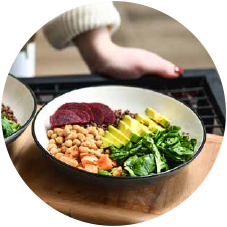
  • Eat a healthy balanced diet

  • Avoid fatty, spicy or processed foods

  • Avoid eating more than 3 portions of fresh fruit a day (a portion is 80g)

  • Incorporate a diet low in fermentable oligosaccharides, disaccharides, monosaccharides and polyols (a low FODMAP diet), which works for about a half to two thirds of people with IBS. This involves cutting out high FODMAP foods, such as: certain fruits (e.g. apples, cherries, peaches); some green vegetables (e.g. broccoli, peas); and most lactose-containing foods

  • Avoid triggers – these can be identified by keeping a food diary and linking likely triggers when symptoms occur

FOR CONSTIPATION: Increase the amount of soluble fibre consumed – good sources include oats, pulses, carrots, peeled potatoes and linseeds (whole or ground).20

FOR DIARRHOEA: Cut down on high-fibre foods like wholegrain foods (such as brown bread and brown rice), nuts and seeds. Also, avoid products containing the sweetener sorbitol.20

WHEN TO EAT20

  • Eat regular meals and don’t eat them too quickly

  • Do not skip or delay meals

WHAT TO DRINK20

  • Try to drink at least 8 to 10 drinks (1.5 litres) a day, such as water or a non-caffeinated drink

  • Avoid excessive alcohol and fizzy drinks

  • Have no more than 3 cups of tea, coffee or other caffeinated drink a day

FOR CONSTIPATION: Drinking more water can aid constipation symptoms by making stools softer.

REFERENCES

1. GI Society Canadian Society of Intenstinal Research. Brain-Gut Connection and IBS. 2023.
Available at: https://badgut.org/information-centre/a-z-digestive-topics/brain-gut-connection-and-ibs/

2. NICE CKS. Irritable bowel syndrome. 2025. Available at: https://cks.nice.org.uk/topics/irritable-bowel-syndrome/

3. Guts UK. Irritable Bowel Syndrome (IBS). 2025.
Available at: https://gutsuk-media-offload.s3.eu-west-2.amazonaws.com/2025/07/IBS-patient-information-July-2025.pdf

4. Hanning N, et al. Intestinal barrier dysfunction in irritable bowel syndrome: a systematic review. Therap Adv Gastroenterol.
2021 Feb. doi: 10.1177/1756284821993586

5. Petrisor DC, et al. Dig Dis Sci. 2024;69:161–168.

6. Eutamene, H et al. Expert Rev Gastroenterol Hepatol. 2018;12(1):83-90.

7. Armova M, et al. Gastrointest Disord. 2025;7:19.

8. Santos J. Poster presented at Gastro 2021; 9–11 December 2021, Prague, Czech Republic.

9. Filippone A, et al. J Clin Med. 2022;11(23):7073.

10. Paterniti I, et al. (P0617). United European Gastroenterol J. 2021;9:(Supplement 8).

11. Campolo M, et al. United European Gastroenterol J. 2021;9 (Supplement 8).

12. de los Rios CC, et al. Ther Adv Gastroenterol. 2021;14:1–10.

13. Trifan A, et al. United European Gastroenterol J. 2019:7(8);1093–1101.

14. Fybogel Plain Granules. Summary of Product Characteristics. Accessed March 2026.
Available at: https://www.medicines.org.uk/emc/product/5652/smpc.

15. Laxido Orange, powder for oral solution. Summary of Product Characteristics. Accessed March 2026.
Available at: https://www.medicines.org.uk/emc/product/6399/smpc.

16. Dulcolax Adult 5mg Gastro-resistant Tablets (GSL). Summary of Product Characteristics. Accessed March 2026.
Available at: https://www.medicines.org.uk/emc/product/361/smpc.

17. NHS. Symptoms of IBS. 2025. Available: https://www.nhs.uk/conditions/irritable-bowel-syndrome-ibs/symptoms/

18. Goodoory, VC, et al. Gastroenterology. 2023;165:1206–1218.

19. World Gastroenterology Organisation Global Guidelines. Probiotics and prebiotics. February 2023. Accessed September 2024.
Available at: https://www.worldgastroenterology.org/UserFiles/file/guidelines/probiotics-and-prebiotics-english-2023.pdf

20. NHS. Diet, lifestyle and medicines for IBS (irritable bowel syndrome). 2025.
Available at: https://www.nhs.uk/conditions/irritable-bowel-syndrome-ibs/diet-lifestyle-and-medicines/

References last accessed June 2026.

Adverse events should be reported. Reporting forms and information can be found at www.mhra.gov.uk/yellowcard or search for the MHRA Yellow Card in the Google Play or Apple App Store. Adverse events should also be reported to Reckitt Benckiser Healthcare (UK) Ltd on 0333 200 5345.

Change privacy settings