Pharmacies are paying 14-15 times more for medicines since start of the year
Neil Trainis,
27 Apr 2026 1 Min
1 Min

Neil Trainis,
27 Apr 20261 Min
Neil Trainis,
27 Apr 20261 Min


The National Pharmacy Association chair Olivier Picard has warned the Government the cost of some commonly prescribed medicines has risen 14 to 15 times since the start of the year, putting huge pressure on pharmacies across England and jeopardising supply to patients.
His comments, posted on LinkedIn, came shortly after he spoke to BBC Radio 4 last Thursday when he said pharmacies were continuing to dispense at a loss as the supply chain becomes “increasingly fragile” and pharmacists deal “with a broken system”.
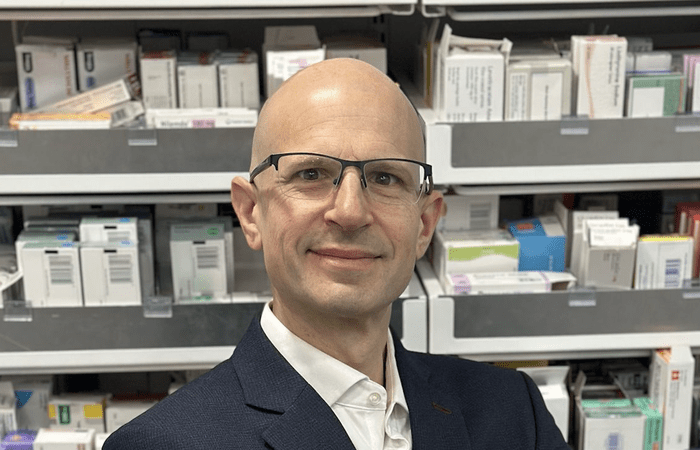
“We are seeing an increasing number of drugs that are more expensive to purchase for pharmacies than they actually get reimbursed,” Picard (pictured) told presenter Evan Davis.
“We see a number of shortages increasing. The Government is having to introduce special protocols so pharmacies can issue limited number of supply.
“Basically, what’s happening is we are dealing with a broken system, a system that is supposed to offer stability for patients and clearly doesn’t do that.”
In his LinkedIn post, Picard wrote: “My pharmacies and the 6,000 National Pharmacy Association are now seeing some commonly prescribed medicines cost 14-15 times more than they did at the start of the year.
“In many cases, reimbursement simply isn’t keeping up, leaving pharmacies to absorb the difference just to ensure patients don’t go without.”
There’s nothing pharmacies can do
Picard was reported in The Guardian last week as saying the price he pays wholesalers for a pack of 100 500mg paracetamol tablets had risen from 41p to £1.99 by end of March, although it had since dropped to £1.09.
The price of hay fever medication cetirizine is also reported to have risen. Picard said the price he pays for a pack of 30 tablets nearly doubled to 37 pence while some distributors are reportedly charging £3.
When asked how rising costs are impacting the availability of medicines on the shelves and over the counter in pharmacies, Picard told BBC Radio 4: “Unfortunately, a lot of those tablets like paracetamol are used both on prescription as well as sold over the counter.
“When a price increases for pharmacies and it’s an NHS prescription, then there’s nothing the pharmacies can do. But when the medicines are sold over the counter, then the pharmacists, whilst they don’t want tol do that, reluctantly have to pass some of those increases to patients.”
When asked what is happening to wholesale prices and what drug manufacturers are saying about their “ability to deliver”, Picard said: “The cost of drugs in the UK has got to such a low level that it is costing the manufacturers more to manufacture their drugs than the NHS is prepared to pay for.
“That has a combination of reasons; the cost of living rising but also the conflict in Iran which is causing the cost of commodities like petrol and transport and raw ingredients which are also increasing.
“Unfortunately, unless the NHS is prepared to pay more for drugs, the manufacturers who are global tend to say ‘well, I’ll prioritise my limited stock to a market that gives me a better return’. And very often, that is not the UK.”
Put more money in system to guarantee supply
Petrol prices have also increased as the US-Iran war has raged and Picard warned in his post that although there were “no immediate shortages linked to the Middle East, manufacturers are warning that ongoing disruption could make supply issues inevitable”.
“Even when medicines don't pass directly through affected routes, key ingredients and transport costs are already being hit,” he wrote. He told BBC Radio 4 that rising petrol prices were playing “a huge part” in the increasing cost of medicines.
Urging Labour “to put more money in the system to guarantee supply for patients”, Picard said: “(Petrol) is a huge part because there is an expectation that the drugs that we use in the UK are manufactured in the UK. Actually, the majority of them are manufactured abroad.
“Raw ingredients come from China, drugs are manufactured in India then transported from India to Europe, imported from the European Union into the UK. Drug manufacturers are global entities, they are not UK-based companies generally and therefore, the cost of manufacturing and transporting these drugs is enormous.
“When the price of petrol doubles, then it pushes the price of production enormously. We’re not asking the NHS to pay more for drugs but actually, what’s happening is the level of prescriptions, the number of drugs being used in the UK is increasing. The drug bill isn’t.”
Tell us about your experiences. How are rising costs of medicines impacting you and your patients? Email neil.trainis@1530.com