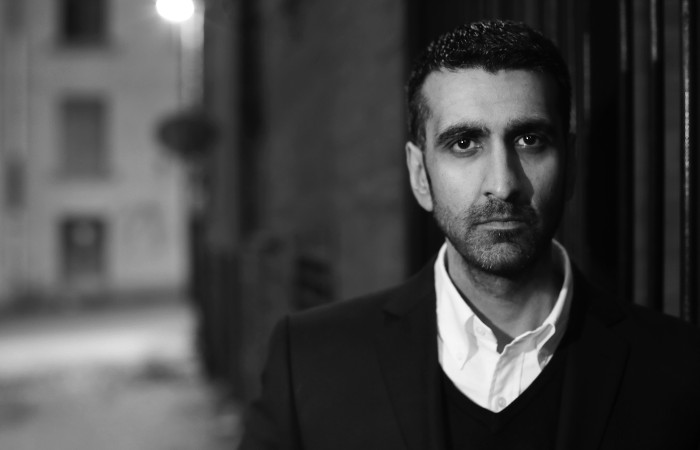
Interview: Amit Dhand
Neil Trainis,
21 Jan 2026 1 Min
1 Min

Neil Trainis,
21 Jan 20261 Min
Neil Trainis,
21 Jan 20261 Min


Amit Dhand used to run a pharmacy in Leeds and now allows his imagination to run wild as a crime fiction writer. The Sunday Times bestselling novelist talks to Neil Trainis…
For Amit Dhand, the pharmacist who wrote a Sunday Times top 10 bestseller called The Chemist, art has not imitated life but real-world experiences have liberated him to capture people’s imaginations.
If that sounds overly dramatic, then consider the 100-hour pharmacy he used to own in Leeds gave him creative inspiration to think up story plots after closing time. Amit, better known to his readers as crime fiction writer A.A Dhand, says Headingley Pharmacy was where “idea creation happened”.
As we chat, he recalls it was an extremely busy pharmacy, “a monster pharmacy really”, looking after nursing homes and doing 20,000 items a month at its peak. The Tories’ funding cuts forced him to sell the business to a corporate just over two years ago but he fondly remembers working after hours helped elevate him to new literary levels.
“I used to love the night shifts. I used to check a lot of dosette boxes in nursing homes and I always liked to be alone. I’d put music on, scores to epic movies, a wicked soundtrack, dim the lights, create that goth and dark night vibe. It was like my writing office, you just check prescriptions and get ideas.
“It’s crazy but when you’re doing another task that requires a lot of attention and has a hundred per cent of your focus, the little plot points you’re stuck with in writing solve themselves in the back of your mind.
“I can’t explain how these things work. I don’t think any writer can. But when you’re doing a task which is completely unrelated to the writing and you have writer’s block, it never fails to solve the problem. I got a lot of ideas working in the pharmacy.”
Amit says the “night-time and the darkness” brought out the best in him – “I’ve always loved writing in the middle of the night.” His admission reminds me of a line from a character played by Jack Cassidy in a 1970s episode of Columbo – “In the mystery writer's soul it is always the middle of the night.” In Amit’s case, substitute mystery writer for crime writer.
Now composing fiction full-time, the night and the darkness are as essential to him now as they have ever been. “I’m a bit knackered. I tend to write at nights when I’ve got a deadline. When the pressure’s really on, I tend to put in nights and write 8am to 8pm. Afterwards, I want to go to sleep,” he says wearily, chuckling slightly.
Writing and years in pharmacy inextricably connected
He’s been working on The Kingpin, his eighth novel and the follow-up to The Chemist, which tells the story of a fictional pharmacist called Idris Khan who is caught up in a turf war between two drug cartels in Yorkshire.
Amit’s writing career and the years he spent working in pharmacy are inextricably connected. Pharmacy helped him bring The Chemist to life. The book’s blurb reads: “Idris Khan spends his days doling out methadone to hundreds of addicts in his care. They trust Idris with their secrets and so he knows more than his mild manner suggests. So, when his childhood sweetheart Rebecca doesn't turn up for her daily methadone dose, Idris is worried. Worried enough to go looking for her in the most deprived area of Leeds, alone.”
I confess I haven’t read the book but the plot sounds interesting and I’m intrigued to know how Amit’s personal experiences influenced the story. He says using pharmacy “as a backdrop for crime fiction” helped make The Chemist his “most successful novel”. It’s a fascinating suggestion.
“Idris is very quiet, very cerebral and the way he takes down the cartel is truly mesmerising,” he says. “I say that as the person who wrote it, not to be egotistical, but Idris kills somebody with a medication that everyone’s got at home on their shelf that you can buy from a corner shop. It’s not always about methadone or oxycodone, it’s just about the simplicity of certain medication being really deadly in certain circumstances.
“If you’re taking down a cartel who have tortured and killed innocent people, audiences love the fact that bad guys get their comeuppance. If that happens to be your local community pharmacist who’s doing it, under the radar and the police can’t catch him because the toxicology reports say it’s not a poison, it’s just a normal medication that people take…”
While Amit wrote the book, he went on nights out with methadone addicts, who he describes as his “blue scripts”. He insists he didn’t use them for research but suggests those nights out gave him “a view into their world”.
“I never called them ‘addicts’, I called them ‘blue scripts’ because you think ‘addicts’ and you get a very specific picture of what that might be and it’s always a negative connotation.
All his addicts, his 'blue scripts’, had a story to tell
Amit knew the blue scripts well because they came to his pharmacy for treatment and affectionately called him The Chemist. On one occasion, they took him to Beeston which, as he recalls, had just become “the first legalised red-light district in Yorkshire”.
“Some of the girls were on my (pharmacy’s) books who worked there, so they knew me really well. So, I had this existence where I was fondly known as The Chemist but it allowed me access to all areas because everyone trusted me.
“I wouldn’t say I was using them for research because The Chemist was completely fictionalised. Yes, they knew I was a writer. God, I’d given them signed books, I’d go on nights out with them when they would always introduce me as a writer. They were as fascinated by me as I was by them.”
Amit says all his blue scripts “had a story to tell” but their descriptions were “too hyperbolic at times” even for a writer looking for a captivating plot.
“Some of their stories were so incredibly maverick and mental that you just couldn’t help but listen. But it was more about the character profiles and the vulnerabilities.”
A sudden, distressing experience generated a creative spark. A harrowing incident that has stayed with Amit – the murder of someone he knew who was run over and killed near his pharmacy – got his mind roaming and he
“I was working late in the pharmacy and on one particular day…it’s a really horrible story…someone I knew died outside the pharmacy. Headingley was in lockdown, there were police everywhere, helicopters in the air.
“So, I locked the pharmacy. I’m doing a late shift and I’m really quite troubled by this. I was checking the dosette boxes and I walked around the pharmacy and this idea popped into my head. I thought ‘if a drug dealer walked into my pharmacy and threatened to kill me and everyone I love unless I supplied all of my blue scripts heroin instead of methadone, that would be a really bad situation to be in’.
“I thought ‘how would I as a pharmacist get out of that situation?’ I’m walking around the pharmacy and looking at all the medications, sertraline, amoxicillin, aspirin, and I start to weaponise the medications to think ‘how can I use legal medications in order to take out a drug cartel?’”
As a pharmacist, he realised he ‘might have real power’
It was the moment Amit realised that as a pharmacist, he “might have real power”. He might have the ability “to manipulate legal medications to create a poison”. The outline of a story started to take shape.
“The only difference between a medication and a poison is the dose. And this idea just popped into my head. Breaking Bad. I thought ‘how can a pharmacist take the fight to a drug cartel who were blackmailing him?’ And my head just exploded with ideas.
“That’s probably the best and successful example I’ve got of being in a pharmacy late at night and having a thunderbolt of an idea which turned out to be my most successful novel.”
He initially wrote The Chemist as a screenplay “in a frenzy of about two weeks” before deciding to turn it into a novel. “You get these moments as a writer where you’re on fire and you don’t want to stop writing because you’re in fifth gear, all the ideas are going and god, if you stop at that point, you’re terrified you’ll never start again.”
Listening to Amit talk about his relationship with his blue scripts reminds me of a conversation I had years ago with a pharmacist who told me dealing with one of his methadone addicts made him nervous because he never knew what mood the addict would be in when they came to his pharmacy.
Talking is often taken for granted but it’s a skill that, when used effectively, can get people to open up. It’s a powerful tool for psychologists, teachers, the police, pharmacists. Amit’s ability to communicate with his blue scripts was honed from childhood.
Growing up, his mother Veena and father Bharat ran a small convenience store in Bradford which they opened in 1982. Amit says his “upbringing behind the counter of a corner shop serving 300 customers a day” gave him an early, intimate insight into effective communication. That nascent experience stood him in good stead when his blue scripts came to his pharmacy.
“I found it challenging at times when they were having a particularly bad day. But because I’ve always been able to say ‘do you want a cup of tea’, I’ve got a corner shop background, I’ve been brought up in a world where you always have time for the customer, I applied the same to my blue scripts.
“If they were hungry, I’d wait to see if they wanted anything. I always had an open-door policy. They live in this very unique, at times very stressful world, and a lot of the time they do need five, 10 minutes just to have a chat.”
It sounds like the blue scripts enjoyed being around Amit on their own turf, in the bars and nightclubs of Leeds, away from a pharmacy environment. They didn’t feel he was intruding into their lives.
“I never used to open the door to them because it was research, I opened the door because they needed a moment, they needed a cup of coffee. I would always just sit and listen to what they were offering.
One addict wrote poetry. All of them wanted to write
“I never went out with them on a research night for my novel. I would hang out with them to get a view of the world. The Chemist is a work of fiction. It’s based on an international drug smuggling racket which I never got anywhere near in my work as a community pharmacist.”
Far from being introverted and withdrawn, his blue scripts were enthusiastic and outgoing. Amit once did a mini documentary with a news crew for a potential TV programme and remembers they “wanted to get involved with that”.
“In those moments, they were very open because we were covering a specific part of their lives,” he recalls. One blue script wrote poetry. All of them wanted to try their hand at writing.
“I remember the one who wrote amazing poetry, very dark, very, very upsetting and I thought that was really fascinating. I was there to listen and give them time.
“The thing about being a blue script or being in the world of addiction, and that doesn’t matter if you’re an alcoholic or a heroin addict or a food addict, whatever addiction you have, you just want to talk. And I was always there to listen.”
Amit is still on the pharmacy register and although he hasn’t practised since 2023, he admits he’s still “passionate about the career of being a pharmacist”. He misses talking to people, not only his blue scripts, but anyone who walked into his pharmacy.
“I had more cups of tea with non-blue scripts than I did with blue scripts. I miss that part of the job.”
He will never run his own pharmacy again
Running the pharmacy was challenging. “I loved it until 2018,” he says pointedly. “I was forced to sell because financially, I was kind of going to rack and ruin.” He insists he will never run his own pharmacy again but he’s regretful he had to let go of something he built up.
“There was nothing there, there was no pharmacy. I opened a 100-hours in a medical centre. I had 12 staff at its peak, five nursing homes, 250 dosette boxes, 11,000 patients and it was such a community hub. But government doesn’t value pharmacy and once they cut the funding, I had to sell.”
The last few years running the pharmacy were almost unbearable. Covid was particularly horrific. Veena, the biggest influence in his life, died during the pandemic.
“She had this incredible work ethic,” Amit reminisces. “My father was poorly a couple of times. She would wake up at 6am, run upstairs, get the kids up, it was breakfast back downstairs and a taxi would come to take us to school because my father wasn’t very well.
“She would run the shop until 1pm, then close it. She’d drive to the cash and carry from 1pm to 2pm, do a quick shop, come back, open then shop again. At 4pm, the kids would come home, she’d run upstairs, cook dinner for them, come back downstairs, do 4pm until 8pm (at the shop), 8pm close up, do all the returns, do all the paperwork, come upstairs, bath us and make sure we’d done our homework, put us to bed, go to sleep, start the next day again.”
A sign hanging on the wall of Amit’s writing office in his house reads: ‘Nobody cares, work harder’. It was advice Veena often gave her son. “The second thing she’d say was ‘you work until the work is done’. I carried that forward. If anyone said to me ‘how are you able to be a pharmacist, a novelist, a screenwriter’, it was those two things. You work until the work is done and stop complaining, nobody cares, just work harder. She was very inspirational.”
Amit understood the essence of community through Veena, who did not speak a word of English when they bought the store but, as he fondly recounts, went through “an incredible transformation” to become “the heavyweight of the community”.
“By the time we finished, the corner shop was really busy and she was running the National Lottery terminal, the PayPoint machine and customers would walk in and be like ‘can I have 20 Regal, Thunderball, £10 top-up on my mobile phone, a newspaper and a packet of crisps’ and seconds after getting all this intel, bang, she’s served them, given them the change and off they go.”
Amit has memories of coming down into the shop as a boy and seeing a customer in the staff room crying because they had “a family drama going on”. Veena would offer them a cup of tea and a chat. He also remembers his mother paying for someone’s wedding because they couldn’t afford it.
“It was just a registry office. They needed 28 quid to get the registry office done and she gave them that. Somebody else came in collecting for their mother who was dying of cancer and they wanted a specific amount of money, I think it was 250 quid to do something she would remember.
“My mum just gave them the 250 quid. She just really ingrained herself in the community. And I thought to myself ‘god, I want to practise pharmacy like that’.”
One of Amit’s “most powerful” memories was his mother’s hearse driving down a road lined with people from the local estate clapping in memory of her. “We had the funeral and I made the driver pass the convenience store as a testament to the 35 years she worked there. There were customers of all walks, young boys, pensioners who had known my mum for 35 years, everyone’s clapping.
“I managed to keep myself in check up until then and I just burst into tears because it was the single greatest moment that I’ve ever experienced.”
Broke the stereotypical depiction of South Asians on screen
Other memories come flooding back, such as the racism Amit and his family suffered in 1982 when they “moved into that estate as the only brown family”. Their windows were smashed and they endured constant abuse.
Years later, Amit would take great satisfaction that another of his literary creations, Harry Virdee, a detective who hunts a killer targeting Bradford’s Asian community, broke the stereotypical depiction of South Asians in a television series screened last year.
“There had never been, until Harry Virdee, a South Asian hero on screen. It was always Goodness Gracious Me, comedic, a bit of a p*ss-take.”
Community shaped Amit’s life from an early stage and is a strong theme in his writing. Bharat, who worked in a mill in London before being made redundant, moved the family to Bradford when Amit was two. Bharat, too, had a strong sense of community.
“My dad was really keen on integration, assimilation,” Amit says. “I’d always have to greet everyone with ‘good morning’ or ‘good afternoon’. God, if I didn’t say ‘good morning’ when they walked in, I got such a telling off.
“All these old school things, good customer service, I transferred to the pharmacy world. For me, working in the pharmacy was just an extension of the convenience store.”
Writing is Amit’s addiction. “I write because I’m unable to not write. It’s my way to deal with the world. I need to put my thoughts on the page otherwise my head explodes. I do it because it’s cathartic and I do it because I love it.”
Since he describes writing as “cathartic”, I wonder if any of his blue scripts wanted to write to help them deal with their problems. “All of them wanted to write a book. All of them have incredible stories. None of them actually did it but they all wanted to write something, whether it was diaries or just snippets of information.
“When you have trauma in your life, if you don’t put it on the page or you don’t speak about it, if you don’t expel it from your mind, it consumes your mind.”
A thought; if pharmacists tried to write a book, perhaps they would expunge all professional difficulties from their minds, at least for a while. With a nod to Michael Douglas in Falling Down, maybe there’s a dark tale about a pharmacist who can no longer stomach government underfunding and medicines shortages and goes on the rampage.
How does a story about the arduous existence of a pharmacy owner grab Amit? “Yeah,” he says chuckling again. “It’s called The Chemist.”
This interview took place on August 29, 2025.